Why Drone Crop Treatment Is Changing How UK Farms Work
A fresh look at an old job
Anyone who has spent a spring walking a wet headland knows the feeling. The crop is ready, the conditions are right, and the ground will not carry a tractor. You either wait and risk the weather turning, or you push on and accept the damage. That trade off has shaped farming decisions for generations. Lately though, more growers are finding a third option, and it sits in the sky rather than on the soil.
Drone crop treatment has moved from a novelty to a working tool on UK farmland. It is not about replacing tractors or sprayers entirely. It is about doing certain jobs better, faster, and with less compaction. When the ground is wet, when the crop is too tall to drive through, or when you need to treat a small patch that does not justify a full rig, an agricultural drone can step in. The result is a more flexible approach to crop protection and nutrition, one that fits around the crop rather than forcing the crop to fit around the machinery.
What drone crop treatment actually involves
At its simplest, drone crop treatment means using an unmanned aircraft to apply something to a crop. That something might be a pesticide, a fungicide, a herbicide, or a dose of fertiliser. It can also mean seed drilling in areas that are too wet or too awkward for a conventional drill. The drone carries a tank or a hopper, flies low over the field, and releases the product in a controlled pattern.
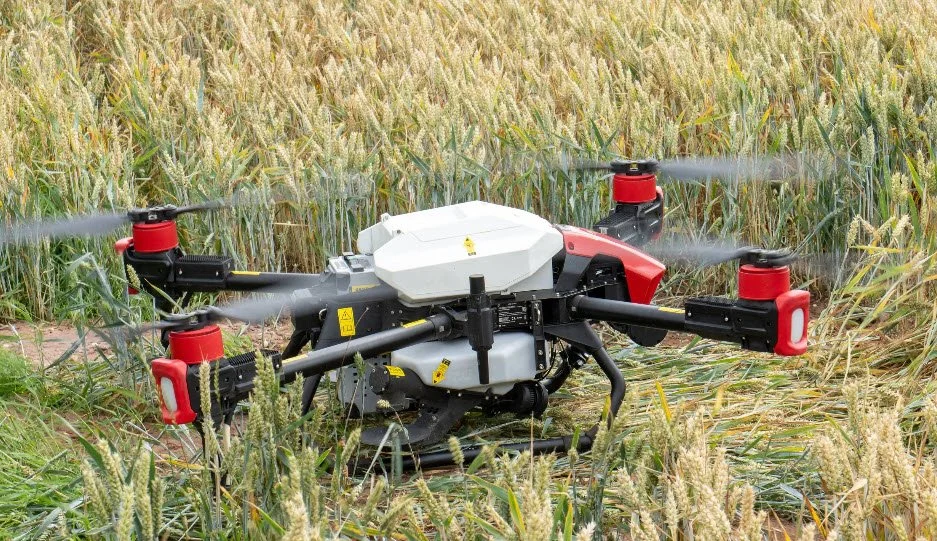
The kit has come a long way in a short time. Modern systems like the DJI Agras range are built specifically for agricultural work. They carry enough payload to cover a few hectares per flight, and they use sensors and GPS to keep the application accurate. The pilot sets the field boundaries, marks any obstacles, and the drone works its way across the crop in neat passes. It is not a toy with a sprayer bolted on. It is a precision tool, and it shows in the results.
Precision where it matters
The real strength of drone spraying is not speed, although it is quick. It is precision. A tractor sprayer covers a wide boom, but it cannot always adjust for variability within the field. A drone can. With variable rate application, the drone changes the amount of product it releases based on a preloaded map. Where the crop is thin, it applies less. Where the crop is thick or showing stress, it applies more. That kind of targeted approach saves money and reduces waste, both of which matter on tight margins.
It also helps with crop scouting. Before the drone ever applies anything, it can fly over the field and collect geospatial data. That data builds a picture of crop health, weed pressure, or pest damage. You can see a problem before it spreads, then treat it with the same drone. It is a closed loop, from observation to action, and it happens in hours rather than days.
The practical benefits on the ground
Ask a farmer who has used a drone for top dressing and you will hear a similar story. The job gets done without rutting the field. There is no compaction from tractor wheels, no damage to the crop from a heavy boom, and no waiting for the ground to dry out. That matters in a wet spring, and it matters even more on land that is prone to waterlogging.
There is also the safety angle. Applying certain products, especially in tall crops or on slopes, can be risky for a driver. A drone keeps the operator out of the field and away from the spray. It is not just about comfort. It is about reducing exposure to chemicals and avoiding accidents.
Then there is the timing. Some treatments have a narrow window. A fungicide needs to go on before the disease takes hold, and a herbicide works best when the weeds are small. Waiting for a contractor or for a gap in the weather can mean missing that window. A drone can be on site quickly, and it can work in conditions that would stop a ground rig. That flexibility can be the difference between a clean crop and a compromised one.
Where drones fit alongside conventional methods
Drones are not a replacement for every sprayer. On large, flat fields with good access, a tractor mounted boom is still the most efficient way to cover ground. The economics are simple: a drone carries less product and covers fewer hectares per hour than a 24 metre sprayer. But that is not the point. The point is that drones fill the gaps where conventional equipment struggles.
For example, consider a field with a wet corner that always gets poached. Instead of driving through it and making things worse, the grower sends in a drone for that section. Or think about a late season top dressing when the crop is too tall to drive through without flattening it. The drone flies over the canopy and applies the fertiliser without touching a single stem. Those are jobs that previously went undone or caused damage. Now they are routine.
There is also a place for drones in integrated pest management. When you find a patch of weeds or a pest outbreak, you can treat just that area instead of the whole field. That reduces the amount of pesticide you use, which is better for the environment and for your wallet. It also slows the development of resistance, because you are not putting selection pressure on the entire pest population. That is a long term benefit that is easy to overlook.
Regulation and the practical side of flying
Flying a drone for agricultural work is not something you can do without preparation. The Civil Aviation Authority sets the rules, and they are strict. You need the right permissions, and you need to understand airspace, safety distances, and data protection. That is not a barrier, but it is a reality. Any serious operator will have the paperwork in order before they take off.
There is also a skill element. Flying a drone low over a crop, close to obstacles, in variable wind, takes practice. The best operators treat it as a craft, not just a job. They know how to read the weather, how to plan a flight path, and how to react when something unexpected happens. That experience shows in the quality of the application.
For farmers who do not want to buy their own drone, hiring a contractor is a sensible option. A contractor brings the equipment, the expertise, and the permissions. They also bring a fresh set of eyes. Sometimes a contractor will spot an issue in the crop that the grower had missed, because they are looking at the field from a different perspective.
Agronomy and data working together
The clever part of drone work is not the flying. It is what you do with the information. A drone flight generates geospatial data that can be turned into yield mapping, crop health indices, and treatment maps. That data feeds into the wider precision agriculture system on the farm. It helps with decisions about seeding rates, fertiliser applications, and variety choices.
Agronomists are starting to use drone imagery as a standard part of their service. Instead of walking every field, they can review aerial images and pick out the areas that need attention. That saves time and makes their advice more targeted. It also gives the farmer a visual record of the season, which can be useful when it comes to reviewing what worked and what did not.
A practical example from a wet spring
Imagine a farm in the Midlands with a field of winter wheat. The crop has come through the winter well, but the spring has been wet. The farmer needs to apply a top dressing of nitrogen, but the ground is too soft for the spreader. A contractor arrives with a DJI Agras drone. They map the field, set the variable rate plan, and start flying. Each flight covers a few hectares, and the drone lands to be refilled. By the end of the day, the whole field has been treated. The crop gets its nitrogen, the soil stays in good condition, and the farmer has not lost a single day to weather.
That scenario is playing out on farms across the country. It is not science fiction. It is everyday practice for a growing number of growers. And it is not just about convenience. It is about making the most of every input, every hour, and every hectare.
What the future holds
The technology is still evolving. Batteries are getting better, payloads are increasing, and the software is becoming more intuitive. It will not be long before drones are as common on farms as quad bikes. The potential is there, and the results are already proving themselves.
Drone crop treatment is not a magic bullet, and it is not for every situation. But for the jobs it does well, it is hard to beat. It offers a level of precision and flexibility that ground equipment simply cannot match. For UK farmers facing tighter margins, stricter regulations, and more unpredictable weather, that is a valuable combination.
The next time you are looking at a field that needs treating and the forecast says rain, or the ground says no, it might be worth looking up. The answer could be flying towards you.